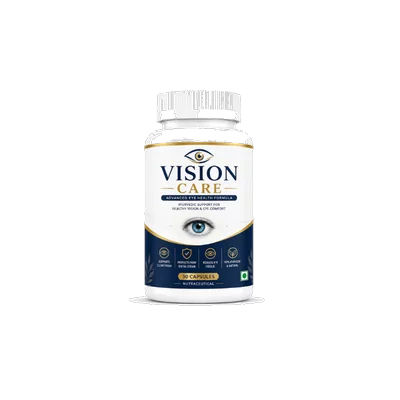
Vision Care is an adult capsule supplement for people seeking nutritional support as part of their eye-care routine. Its benefit is to complement balanced nutrition and healthy visual habits, not to correct refractive errors or replace medical treatment.
Description
Vision Care is a dietary supplement supplied as capsules for adults who want nutritional support within an eye-health routine.
Composition
Vision Care is a dietary supplement supplied in capsules for adults. The product contains 30 capsules, but the active ingredients, quantities, and full composition are not provided here; check the pack for exact composition details.
Dosage and usage
Dose: The amount per dose in mg is not provided; follow the capsule quantity stated on the pack.
Frequency: The number of doses per day is not specified; follow the instructions on the pack.
Timing: The recommended relation to meals and time of day are not provided; check the pack for timing instructions.
Duration: The intended course length is not specified; use the product for the duration stated on the pack.
Route: Take orally as capsules with water.
How it works
Vision Care is a dietary supplement rather than a medicine with a specified pharmacological mechanism. Its intended role is to provide nutritional support for normal body functions, including tissues involved in vision, alongside balanced nutrition and healthy eye-care habits.
Indications
Vision Care contains 30 capsules and is formulated as a dietary supplement. It suits people who want to make eye wellness part of a consistent daily routine, including those with frequent screen exposure, visually demanding work, or age-related changes in visual comfort.
Vision Care is best viewed as a daily dietary supplement for eye-health support, not as a treatment for glaucoma, cataract, retinal detachment, infection, or sudden visual loss. Supplements may be useful for people whose diet is inconsistent, yet they cannot reverse structural eye disease.
The Cochrane review on antioxidant vitamins and minerals found that certain formulations may slow progression in people with intermediate age-related macular degeneration, but this evidence does not mean that every eye supplement prevents macular degeneration or improves vision in all adults [1].
Comparison
Vision Care can support an eye-health routine, while eyewear and clinical assessment address different needs. These approaches are complementary rather than interchangeable.
Approach
Main role
Key limitation
Vision Care capsules
Nutritional support for an eye-health routine
Does not correct refractive error or treat diagnosed eye disease
Eyeglasses or contact lenses
Corrects prescribed refractive error
Does not diagnose glaucoma, cataract, or retinal disease
Professional eye test
Detects visual changes and eye-health concerns
Does not replace daily nutrition or protective habits
Contact lenses can offer a wider field of view for some activities, though they require careful hygiene and scheduled replacement. Eyeglasses are easier to remove and do not touch the eye surface. Sunglasses are useful for ultraviolet protection but should not be used to mask persistent glare, pain, or declining vision.
Contraindications
Vision Care is not for you if you have had an allergic reaction to any of its components.
Use added caution in the following situations:
Pregnancy or breastfeeding, unless a clinician who knows your health history supports its use.
Ongoing treatment with prescription medicines, especially anticoagulants, antiplatelet medicines, diabetes medicines, or treatments that require stable nutritional intake.
Liver disease, kidney disease, or a history of recurrent severe digestive symptoms.
Planned surgery, where the surgical team should know about all supplements being used.
A diagnosed eye condition with new or worsening symptoms.
Do not combine several eye-health or multivitamin supplements without reviewing the total nutrient intake. Doubling up can add unnecessary ingredients without improving the result.
When this is not for you
Do not use Vision Care if you have previously reacted badly to one of its ingredients. Speak with a clinician before using it if you are pregnant or breastfeeding, take prescription medicines, have liver or kidney disease, are planning surgery, or have a diagnosed eye condition with new or worsening symptoms.
Side effects
Dietary supplements are usually well tolerated when used as directed, though individual responses vary. Mild digestive upset, nausea, stomach discomfort, headache, or a skin reaction can occur with capsule supplements. Stop using Vision Care and seek medical advice promptly if swelling of the lips or face, wheezing, widespread rash, or severe vomiting occurs.
People often blame a supplement for eye symptoms that have another cause. Dryness, fluctuating focus, and burning after long screen sessions may result from reduced blinking, poor tear-film stability, or an outdated prescription rather than a nutritional capsule.
If stomach discomfort occurs after a capsule, taking it with a meal can be easier for many people than taking it on an empty stomach, provided this fits the product directions.
Common mistakes
Using Vision Care as a substitute for a new glasses prescription when distance or reading vision has changed.
Ignoring one-sided blur because the other eye still sees well.
Adding multiple supplements with overlapping nutrients.
Taking capsules inconsistently, then judging the result too quickly.
Continuing contact lens wear through redness, pain, or light sensitivity.
Assuming headaches are always caused by screens instead of checking vision, sleep, migraine history, blood pressure, and hydration.
Wearing dark sunglasses indoors to manage persistent glare rather than identifying the cause.
A common mistake is waiting until vision loss disrupts work or driving. Early glaucoma may not cause noticeable symptoms, and diabetic retinal changes can progress before central vision feels affected.
What doctors say
In clinical practice, eye specialists separate visual symptoms into two groups: symptoms linked to routine strain or refractive error, and symptoms that may signal disease. A supplement may fit the first group as supportive nutrition, but it must never delay assessment of the second group.
Doctors also tend to ask practical questions first. Is the blur in one eye or both? Did it start suddenly? Is there pain, light sensitivity, flashes, floaters, headache, or diabetes? These details guide urgency far more reliably than the intensity of screen use alone.
Frequently asked questions
Can Vision Care improve eyesight without glasses?
Vision Care is a dietary supplement and does not change refractive errors such as myopia, hyperopia, astigmatism, or presbyopia. Glasses and contact lenses correct these focusing issues, while an eye test determines the prescription needed. The WHO described uncorrected refractive error as a major cause of vision impairment in its 2019 World Report on Vision. Persistent blur needs an eye assessment rather than a higher supplement intake.
Can Vision Care be used for screen-related eye strain?
Vision Care can be part of a general eye-health routine for adults with frequent screen use. Screen-related discomfort is often linked to reduced blinking, dry eye, glare, poor viewing distance, or an outdated prescription. The ICMR–National Institute of Nutrition dietary guidance published in 2024 supports balanced food patterns as the foundation for nutrient intake. Regular breaks and comfortable screen settings remain practical measures.
Does Vision Care treat glaucoma or cataract?
Vision Care does not treat glaucoma or cataract. Glaucoma requires monitoring of the optic nerve and eye pressure, while cataract is managed through ophthalmology assessment and, when appropriate, surgery. The WHO eye-care interventions document published in 2023 identifies professional assessment and treatment pathways for these conditions. New peripheral vision loss, eye pain, glare, or worsening night vision should not be managed with supplements alone.
Can Vision Care be taken with other supplements?
Combining supplements may create unnecessary overlap in nutrients or botanicals. This is more relevant for people already using multivitamins, mineral products, or specialist eye formulations. The Cochrane review published in 2017 evaluated specific antioxidant and mineral formulations for age-related macular degeneration, rather than unlimited combinations of products. A clinician can review the complete list when prescription medicines or chronic conditions are involved.
When should visual symptoms be treated as urgent?
Sudden loss of vision, a shadow across the field of vision, severe eye pain, injury, a red painful eye, new flashes, or a sudden shower of floaters need urgent assessment. These symptoms can indicate problems that are time-sensitive. The WHO has emphasised in its 2019 vision report that timely detection and treatment reduce avoidable vision loss. Vision Care is not an emergency intervention.
Can children use Vision Care?
Vision Care is formulated as an adult dietary supplement. Children with squinting, difficulty reading, frequent headaches, poor school-board visibility, or an eye that appears misaligned need an age-appropriate eye examination. The WHO’s 2023 eye-care package supports structured eye assessment and referral for childhood visual needs. Adult supplements should not be used as a substitute for paediatric eye evaluation.
Vision Care: Reviews and Experiences
R
Ravi, 38
Bengaluru
Using for six weeks
Verified
Rating: 4.5 out of 5
I started Vision Care because long laptop days left my eyes feeling tired by evening. I also began taking proper breaks and using my prescribed computer glasses, so the improvement was gradual rather than dramatic. The capsule was easy to include with breakfast.
15 Aug 2026
M
Meera, 46
Pune
Using for one month
Verified
Rating: 4 out of 5
My main goal was to improve my nutrition routine. I did not expect the capsules to replace my reading glasses, and they did not. I felt more organised about meals and eye breaks, which was useful.
27 Aug 2026
A
Anil, 55
Chennai
Using for three weeks
Verified
Rating: 2 out of 5
I stopped after mild stomach discomfort when I took it before tea without food. Taking supplements with lunch had usually suited me better, but I decided not to restart until I had discussed my full supplement list with my clinician.
31 Aug 2026
S
Shalini, 32
Hyderabad
Using for two months
Verified
Rating: 3.5 out of 5
The capsule routine was simple, though my dry eyes still flared during late-night work. An eye examination showed that I needed a change in my prescription, which made more difference than anything else.
13 Sep 2026
Sources
Cochrane (2017). Antioxidant vitamin and mineral supplements for slowing the progression of age-related macular degeneration