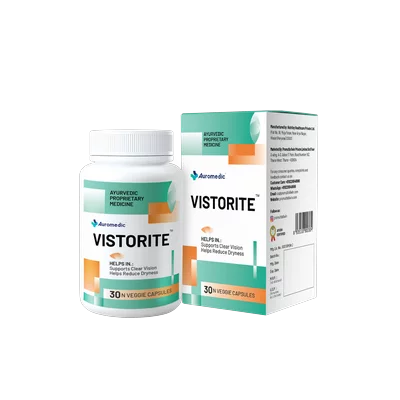
Vistorite is an oral eye-health supplement supplied as 30 veggie capsules. It is intended for adults seeking nutritional support for clear vision and relief from everyday eye dryness. Its role is supportive alongside healthy screen habits, hydration, and regular eye care.
Description
Vistorite is formulated as a veggie-capsule supplement for visual comfort. The product is positioned to support clear vision and help reduce dryness, two concerns often linked with prolonged screen use, air-conditioned rooms, dust exposure, reduced blinking, and age-related changes in the tear film.
The World Health Organization describes vision health as dependent on more than eyesight alone: dry-eye symptoms, refractive errors, diabetes, cataract, glaucoma, and retinal disorders all need different forms of care and assessment [1].
Composition
Vistorite is a veggie-capsule oral supplement for visual comfort. The exact ingredients and amounts are not provided in the available product information, so they should be checked on the product pack. It is intended for adults seeking nutritional support for clear vision and help with everyday eye dryness.
Dosage and usage
Take Vistorite capsules by mouth with water as part of a regular daily routine. Swallow the capsule whole rather than opening it into a drink or chewing it. Taking an oral supplement with a meal is often more comfortable for people prone to nausea from capsules.
A consistent routine helps prevent missed servings:
Take Vistorite at a similar time each day.
Use water rather than tea, coffee, or carbonated drinks to swallow the capsule.
Keep the capsule intact.
If a serving is missed, resume the normal routine the next day rather than doubling the amount.
Track symptoms such as evening dryness, blurred vision after screens, and contact-lens discomfort for several weeks.
How it works
Clear vision depends on the cornea, lens, retina, optic nerve, tear film, and brain processing visual signals. The tear film has three main layers: an oily outer layer that slows evaporation, a watery middle layer, and a mucin layer that helps tears spread evenly across the eye surface.
When the tear film becomes unstable, vision can fluctuate. Letters may briefly look hazy, especially late in the day or after a long period of reading. Burning, grittiness, watering, and a heavy-eyed feeling can occur too. The Tear Film and Ocular Surface Society reports that dry-eye disease is associated with tear-film instability and inflammation, though symptoms vary widely from person to person [2].
Indications
Vistorite may suit people whose goal is daily nutritional support, rather than rapid relief from a sudden or severe eye symptom.
Vistorite has a supportive role in eye-health routines. It is not designed to replace corrective glasses, prescribed treatment for eye disease, or urgent assessment for sudden visual changes.
Vistorite can fit a routine focused on eye comfort, especially when combined with breaks from close work, adequate sleep, and sensible contact-lens habits. It should not be expected to reverse cataracts, correct short-sightedness, restore damaged retinal tissue, or treat raised eye pressure.
Comparison
Vistorite has a supportive role in eye-health routines. It is not designed to replace corrective glasses, prescribed treatment for eye disease, or urgent assessment for sudden visual changes.
Approach
Main role
Best suited to
Vistorite oral capsules
Nutritional support for visual comfort and dryness concerns
Adults building a regular eye-health routine
Lubricating eye drops
Temporary surface moisture and symptom relief
Intermittent dryness, irritation, or screen-related discomfort
Prescription eye treatment
Targets diagnosed inflammatory, allergic, pressure-related, or retinal conditions
People assessed by an eye-care clinician
Lubricating drops may be useful when dryness is immediate and surface-based. Vistorite is more appropriate for people who prefer an oral supplement as part of longer-term daily care. Prescription therapies are reserved for specific diagnoses, such as significant dry-eye disease, allergic eye disease, glaucoma, infection, or retinal conditions.
The American Academy of Ophthalmology advises assessment when dry-eye symptoms are persistent, affect daily activities, or occur with pain, light sensitivity, marked redness, or reduced vision [3].
Contraindications
Vistorite is not for you if you have had an allergic reaction to any of its ingredients or to capsule materials used in oral supplements.
Extra care is sensible in several situations:
pregnancy or breastfeeding;
planned eye surgery;
chronic kidney or liver disease;
diabetes with changing vision;
use of anticoagulants, antiplatelet medicines, or multiple supplements;
regular treatment for glaucoma, retinal disease, thyroid disease, or autoimmune conditions;
unexplained visual loss, eye pain, or persistent redness.
The International Diabetes Federation’s 2023 guidance emphasises regular retinal screening as part of diabetes care [4].
When this is not for you
Vistorite is not suitable if you have previously had an allergic reaction to one of its ingredients or to capsule materials. Speak with a healthcare professional before starting it if you are pregnant or breastfeeding, have kidney or liver disease, diabetes with changing vision, or take anticoagulants, antiplatelet medicines, or several supplements. Do not rely on it if you have unexplained vision loss, eye pain, persistent redness, or symptoms that are sudden or severe.
Side effects
Vistorite is an oral supplement, and most tolerability concerns with capsules are digestive rather than eye-related. Some people may experience mild nausea, stomach upset, bloating, or an unpleasant taste after swallowing a capsule. These effects are more likely when capsules are taken on an empty stomach.
Stop use and seek urgent medical help if signs of an allergic reaction occur, such as facial swelling, wheezing, widespread rash, or difficulty breathing. Eye symptoms also need attention when they are intense or one-sided.
Seek prompt eye assessment for:
sudden loss of vision;
flashes of light, a curtain-like shadow, or many new floaters;
severe eye pain;
pronounced light sensitivity;
eye injury or chemical exposure;
thick discharge with a red, painful eye;
headache with nausea and coloured halos around lights.
These symptoms are not routine dryness. They can point to conditions requiring urgent examination.
Common mistakes
People often expect one approach to fix every eye complaint. Eye dryness, focusing fatigue, allergy, refractive error, infection, and retinal disease may all produce blurred or uncomfortable vision, yet they need different responses.
Common mistakes include:
Taking capsules irregularly, then judging the result after only a few days.
Spending long periods on screens without blinking consciously.
Using redness-relieving drops repeatedly instead of addressing dryness.
Wearing contact lenses longer than planned when the eyes already feel dry.
Assuming watering eyes cannot be dry eyes.
Ignoring one-sided symptoms because the other eye feels normal.
Treating sudden floaters or flashes as ordinary eye strain.
Combining several supplements without considering duplicate nutrients.
One detail patients often miss is that reading on a phone tends to reduce blink rate more than casual conversation or walking outdoors. Smaller text, close viewing distance, and sustained concentration make the eye surface dry faster.
What doctors say
In clinical practice, eye-care professionals often start by separating dryness from reduced visual acuity. A person may say their vision is getting weaker when the main issue is tear-film instability after hours of screen work. Another person may have no dryness at all but need a new spectacle prescription.
Doctors usually look for patterns. Symptoms that appear late in the day, improve after blinking, and worsen in air-conditioned environments often point toward surface dryness. Symptoms such as distorted straight lines, a dark patch in central vision, coloured halos, or sudden floaters need a different level of investigation.
The European Medicines Agency distinguishes between supportive health products and medicines used for defined disease indications. That distinction matters when visual symptoms become persistent or progressive [5].
Frequently asked questions
What is Vistorite used for?
Vistorite is an oral veggie-capsule supplement intended to support clear vision and help reduce dryness. It is suited to adults who want nutritional support for everyday visual comfort, especially when screen exposure, dry indoor air, or reduced blinking contribute to tired eyes. The WHO’s 2019 vision report explains that eye symptoms can have many causes, so ongoing or worsening visual changes deserve appropriate assessment. Vistorite is best viewed as supportive care rather than a treatment for eye disease.
How quickly can Vistorite support eye comfort?
Oral supplements are usually assessed over weeks of consistent use rather than after a single serving. Day-to-day dryness can still vary because of sleep, air conditioning, screen time, allergies, and contact-lens wear. The Tear Film and Ocular Surface Society’s 2017 dry-eye report describes tear-film instability as a fluctuating condition, which explains why symptoms can change during the same day. Keep expectations practical and observe your own pattern over time.
Can Vistorite replace lubricating eye drops?
Vistorite and lubricating drops have different roles. Capsules provide oral nutritional support, while lubricating drops add moisture directly to the eye surface and can offer faster temporary comfort. The American Academy of Ophthalmology’s 2024 dry-eye guidance supports matching treatment to symptom severity and underlying cause. Someone with frequent burning, redness, or contact-lens discomfort may still need eye drops or an examination.
Can people who use screens take Vistorite?
Vistorite may suit adults seeking eye-health support during frequent screen use. Digital work often reduces blinking, which can destabilise the tear film and cause fluctuating vision or dryness. The WHO’s 2019 report recognises that visual comfort is influenced by environmental and behavioural factors as well as eye conditions. Screen breaks, correct display height, larger text, and conscious blinking remain useful alongside capsules.
Is Vistorite suitable when vision changes are related to diabetes?
Changing vision in a person with diabetes should be assessed rather than attributed only to screen strain or dryness. Blood-glucose changes can affect focusing, while diabetic retinopathy may develop with few early symptoms. The International Diabetes Federation’s 2023 clinical guidance supports regular retinal screening for people living with diabetes. Vistorite does not replace diabetes management, retinal screening, or prescribed eye treatment.
When should eye symptoms be assessed urgently?
Urgent assessment is needed for sudden vision loss, severe pain, flashes, a curtain-like shadow, major light sensitivity, eye injury, or a red eye with marked pain. These signs can be associated with conditions that need rapid treatment. The European Medicines Agency’s 2011 quality guidance reflects the distinction between general health products and therapies for defined medical conditions. Vistorite should not be relied upon for acute or rapidly worsening symptoms.
Vistorite: Reviews and Experiences
R
Rahul, 38
Bengaluru
Using for five weeks
Verified
Rating: 3.5 out of 5
I started Vistorite after my eyes felt tired by evening from laptop work. The gritty feeling was less frequent after a few weeks, although I also became stricter about screen breaks. I did not notice a dramatic change in my glasses power, which I did not expect.
26 Sep 2026
S
Sneha, 46
Pune
Using for one month
Verified
Rating: 4.5 out of 5
My main problem was dryness in an air-conditioned office. The capsules were easy to add after breakfast, and my eyes felt more comfortable by the end of the workday. I still used lubricating drops on very long meeting days.
11 Sep 2026
M
Manish, 31
Hyderabad
Using for three weeks
Verified
Rating: 3.5 out of 5
I liked the capsule format, but I had mild stomach discomfort when I took it before food. Taking it after lunch solved that. My eye fatigue improved a little, though late-night phone use still made my eyes feel dry.
6 Sep 2026
K
Kavya, 52
Chennai
Using for six weeks
Verified
Rating: 2 out of 5
I hoped it would fix blur in one eye, but the blur continued. An eye examination showed that I needed a prescription update. Vistorite remained part of my routine for dryness, but it was not the answer to the focusing problem.
29 Aug 2026
Sources
World Health Organization (2019). World report on vision.
Tear Film and Ocular Surface Society (2017). TFOS DEWS II Definition and Classification Report.
American Academy of Ophthalmology (2024). Dry Eye Syndrome Preferred Practice Pattern.
International Diabetes Federation (2023). IDF Clinical Practice Recommendations for Managing Type 2 Diabetes in Primary Care.
European Medicines Agency (2011). Guideline on quality of herbal medicinal products/traditional herbal medicinal products.